Monday, June 27, 2016

Belize, January, 2013

Crooked Tree, Belize and Caye Caulker, Belize

In January, 2013 we traveled to Belize for our delayed honeymoon after our November 2012 wedding. We decided to wait until the horrible cold Wisconsin winter and get away to someplace warm. I love doing travel research and Garry likes using Google Earth to look at places we are thinking about visiting. We decided to spend a few days inland and a few days on Caye Caulker, one of the smaller islands. We were so happy there we never ventured over to the more popular (and busy and expensive) Ambergris Caye. We hope to return again someday soon to explore areas further down the coast of Belize. Garry takes a LOT of photos wherever we go. Here are a few.

After landing in Belize City, we rented a car and drove less than an hour to the town of Crooked Tree. We had a reservation for a cabin at the Crooked Tree Lodge. The property is run by Mick & Angie, and they were great hosts, served fabulous meals and arranged a couple of side trips for us.

Our bungalow at Crooked Tree Lodge

This Basilisk Lizard (AKA Jesus Christ Lizard), 
was well camouflaged on the door to our cabin.


Our hosts arranged a day trip on a small boat with other guests from the lodge, up the New River to Mayan Ruins at Lamanai. The trip included lunch.

The Mask Temple at Lamanai
Along the river we saw many birds, as well as crocodiles and spider monkeys.


Garry wanted to learn more about the birds in the area, so our hosts set us up with a guide early one morning, and we went out in a boat onto the lagoon and saw many birds that I had never heard of, including the jacana.
Common Egret

Jacana

After a few days at Crooked Tree, we returned our rental car and took a cab to the water taxi which would take us over to Caye Caulker. The boat was filled with people and their gear and everyone tried to get a spot away from the water spray. At least it was warm!

Water taxi
The water taxi dropped us at the dock on Caye Caulker, and a bicycle cab took us to  cabana #5 at Costa Maya Beach Cabanas which had a small kitchen area, bed, bath and balcony. Here's the view from our balcony. Our room came with use of bikes, kayaks, and a grill. We were very happy with our choice via the internet.


We rode bikes from one end of the island to the other - about 5 miles one way. The island is about 1 mile wide. No motorized vehicles are allowed on Caye Caulker, except for delivery trucks, etc. If you'd like more information, try this website: Go Caye Caulker.


Caye Caulker street scene - nice and quiet with no cars allowed!


We saw this Coati alongside the main road on Caye Caulker


Garry likes to get up early with his camera and check out the sunrise with the birds.
Immature Frigatebirds
Frigatebirds and Brown Pelicans


Garry hired a fishing guide for part of a day. I went along for the ride. You need to be an experienced fisherman for "sight fishing"; casting your line as the guide spots fish. I enjoyed the boat ride in the sun.
Garry's catch  - a Jack Cravelle


A popular restaurant called Wish Willy's. Seafood was cheap and plentiful on Caye Caulker. With a complete grilled lobster dinner for less than $10, Garry ate it every day! Restaurants ranged from casual rustic to very rustic - grills and picnic tables in back yards.


Our hotel was also the office for Tsunami Adventures, and we booked a snorkeling trip with them, to Hol Chan Marine Reserve, and swam with nurse sharks, sea turtles, sting rays and fish. I had never snorkeled before, and Garry gave me some lessons in the shallow water first.

We met people from all over the world who were living, working or visiting Belize. We didn't meet the owner of this boat but I'm sure he was an interesting character.


Monday, June 20, 2016

Mounting a Quebec Caribou

Mounting a Quebec Caribou

Two caribou in velvet that Garry collected in Quebec in September, 2001

Garry mounted this Quebec Caribou for a customer. For those of you interested in the process of creating a large taxidermy mount, here are some photos of the procedure.

Here is the tanned caribou cape and antlers.


This photo shows the ear cartilage removed, the plastic ear liners and glass eyes. The ear liners and eyes come from a taxidermy supply company.


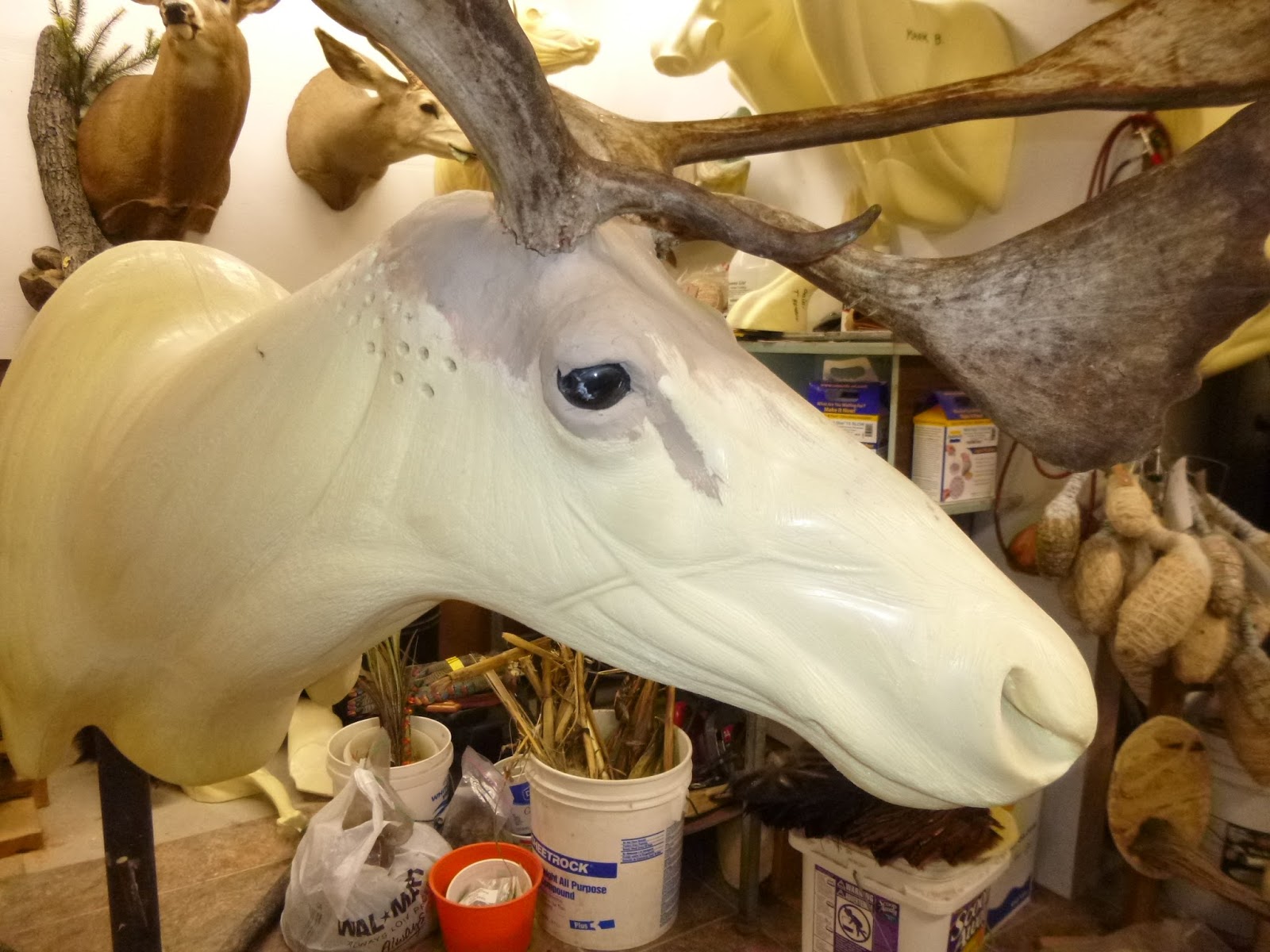
Before the project is started, after measuring the cape and antlers, Garry orders a molded foam manikin from a taxidermy supply company. Here is the caribou form with the antlers attached.


Next, the glass eyes are attached to the manikin using clay.
The eyelids and eyebrows are sculpted in the clay.


Next, the manikin is coated with a special glue (hide paste) for taxidermy.


Here, the skin is ready to be set onto the manikin.


The lip skin needs to be tucked into the slots on the manikin. The mounting stand allows the manikin to be turned so that you can work on it from all sides.


Sewing up the seams!  The mount will need to dry for about 2 weeks.


Finished Quebec Caribou, along with other projects in progress in the shop. The final touches involve epoxy work around the eyes, nose and lips, followed by painting the fleshy areas of the caribou.


This is another finished Quebec Caribou. Note the difference in color of the fur.
Caribou vary a lot in color.


Here's Garry with two caribou with antlers in velvet that he collected on his last trip to Quebec from September 2001. I've named the one mounted on our wall Carlton, and over the holidays he was adorned with gold beads and ornaments. 


Two caribou in velvet that Garry collected in Quebec in September, 2001


Monday, June 13, 2016

Elephant Ear Painting of African Animals

Elephant Ear Painting


Because an elephant ear is shaped like the continent of Africa, it makes the perfect background for a painting of the animals of Africa. Garry's customer in New York requested a painting of animals he had hunted, so Garry mounted this ear onto a plywood backing and the animals were beautifully painted by Wisconsin artist Scott Zoellick. Animals included are an Elephant from Zimbabwe, Cape Buffalo from Tanzania, White Rhinoceros from South Africa, Lion from Tanzania, Leopard from Zambia, Mountain Nyala from Ethiopia, Bongo from Cameroon and Lord Derby Eland from the Central African Republic. Garry's customer was thrilled with the result.  

You can see more of Scott's Zoellick's work at www.thunderart.com