Showing posts with label taxidermy instruction. Show all posts

Sunday, July 1, 2018

Mounting a Life Size Stone Sheep

Here's another completed project. Below, Garry narrates the process for mounting this Stone Sheep from British Columbia. You can see by the many other projects in the shop photos, that he's been very busy! 

Finished Stone Sheep Mount
This Stone Sheep was harvested in British Columbia by a client who is creating a display of life size mounts of his "Grand Slam" of sheep of North America. The "Grand Slam" is a collection of four North American sheep, and includes the Rocky Mountain Bighorn Sheep, The Desert Bighorn Sheep, The Stone Sheep from British Columbia and the Dall Sheep from Alaska, Yukon and Northwest Territories. 

This sheep was shot in the neck with the bullet exiting the left side of the face. There was major damage to the skin, which needed to be repaired. The client called me from British Columbia explaining the damage and was worried about having it repaired. I told him that if all the pieces were there, I would probably be able to fit it all together. 

The skin was tanned at  Carolina Fur Dressing and Rick Morgan's crew did a great job of working around the damaged areas. It was like a jigsaw puzzle putting this all together. It took about four hours to arrange the skin in its proper position, trying it on the mannikin and checking hair patterns. I was pleased with the repairs and I have mounted sheep with more damage and scars from fighting. The mannikin and artificial rock were purchased from  McKenzie Taxidermy Supply Company. 


Mannikin attached to artificial rock. 

Damage from bullet exit wound below left eye.


Sewing the damaged face and checking hair patterns. 

Sewing the tanned skin

Repairs completed.

Mannikin didn't need much alteration.

Relief cuts were made in the groin area of the mannikin.
A dorsal cut was used so the skin will be applied to the mannikin on its back. 

Gluing the legs

Skin is positioned and I started to sew the seams. 

Leg seams are sewn and threaded rods will anchor the mount to the rock.
Testicles are carved from styrofoam. 

Glue applied to the mannikin. 

Skin pulled into proper position.

Face skin lowered while eyes are set into position. 

Horns are affixed with Bondo to the skull and the skullcap is affixed to the mannikin with screws and Bondo. 

Eyes are set in clay and nose detail is sculpted in clay. 

Skin is positioned on mannikin and the full length dorsal incision is sewn. 

Pins are put in place in depressions to hold the skin while drying.
Face detail is also pinned.  

After drying, detail work is finished around the face and feet. 

Finished mount showing where damage on the face was repaired. 

The mount, including the artificial rock, was created to be
hung on a wall when complete. 
Dall Sheep from Northwest Territories, for the same client.

Rock Base created by Dale Manning of Habitat Rock, Missoula, Montana

Sunday, June 10, 2018

Mounting a Life Size Leopard

Leopard taxidermy

Here's what Garry has to say about this project. 

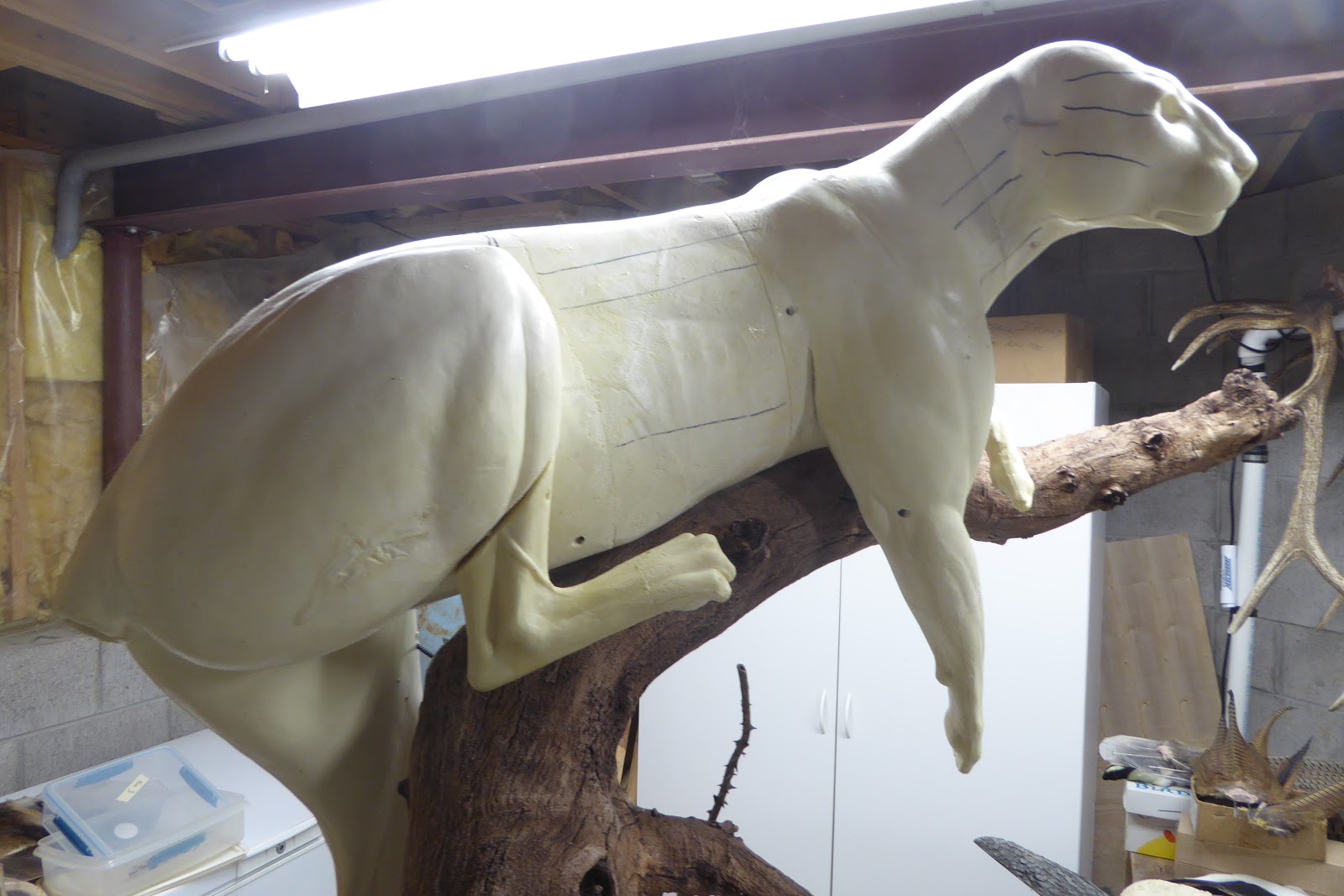
This leopard was collected in Namibia by a client. It was a very large cat, it was not weighed but it was one of the largest cats I've ever worked on. It was bigger than a 165 lb leopard I did a few years ago. I had to alter the largest leopard form I could get, to make it bigger and to fit the artificial tree branch it would be perched on. 

The leopard form was purchased from Research Mannikins Taxidermy Supply in Oregon. This form was sculpted by Bill Lancaster, who does great cats. 


Form before alterations


Fitting the form to the artificial branch. 
The branch was purchased from McKenzieTaxidermy Supply


Form before hip alteration.


I had to cut the form in half to alter the angle of the hips. 

Tuesday, May 8, 2018

Mounting a Lion-Pedestal Shoulder Mount

Finished Mount


Originally the client wanted this lion to be a life-sized mount. It was collected in Tanzania. After over a year of waiting to have the skin shipped from Tanzania, when it arrived from the tannery, there was a lot of damage to the skin. It's not possible to say where the damage took place. Therefore, we decided to do a pedestal shoulder mount.  

The photos below show the process of creating the mount. 

Artificial jaws are fitted to the manikin.

Jaws reattached and ready to mount.

Monday, June 20, 2016

Mounting a Quebec Caribou

Mounting a Quebec Caribou

Two caribou in velvet that Garry collected in Quebec in September, 2001

Garry mounted this Quebec Caribou for a customer. For those of you interested in the process of creating a large taxidermy mount, here are some photos of the procedure.

Here is the tanned caribou cape and antlers.


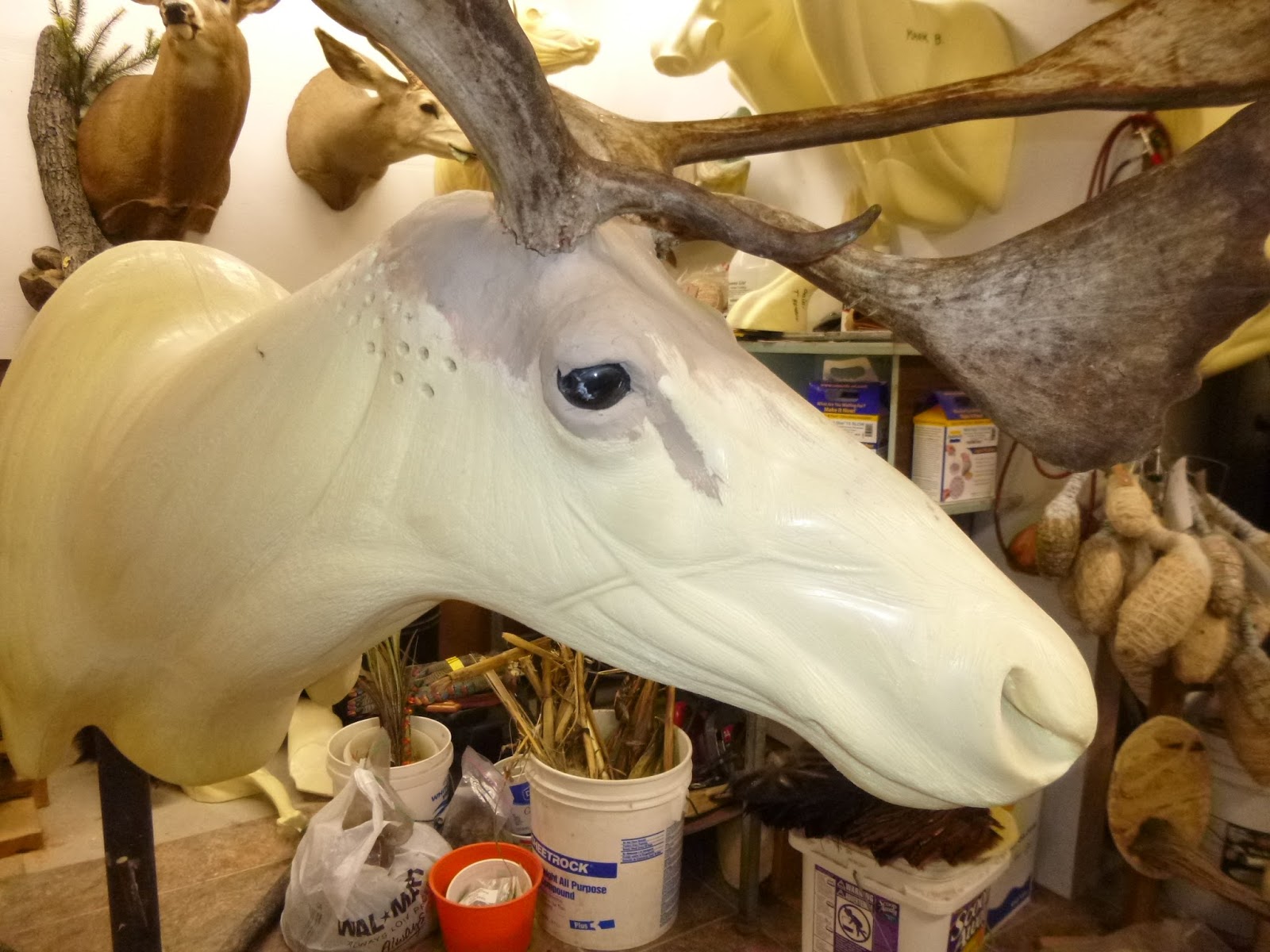
This photo shows the ear cartilage removed, the plastic ear liners and glass eyes. The ear liners and eyes come from a taxidermy supply company.


Before the project is started, after measuring the cape and antlers, Garry orders a molded foam manikin from a taxidermy supply company. Here is the caribou form with the antlers attached.


Next, the glass eyes are attached to the manikin using clay.
The eyelids and eyebrows are sculpted in the clay.


Next, the manikin is coated with a special glue (hide paste) for taxidermy.


Here, the skin is ready to be set onto the manikin.


The lip skin needs to be tucked into the slots on the manikin. The mounting stand allows the manikin to be turned so that you can work on it from all sides.


Sewing up the seams!  The mount will need to dry for about 2 weeks.


Finished Quebec Caribou, along with other projects in progress in the shop. The final touches involve epoxy work around the eyes, nose and lips, followed by painting the fleshy areas of the caribou.


This is another finished Quebec Caribou. Note the difference in color of the fur.
Caribou vary a lot in color.


Here's Garry with two caribou with antlers in velvet that he collected on his last trip to Quebec from September 2001. I've named the one mounted on our wall Carlton, and over the holidays he was adorned with gold beads and ornaments. 


Two caribou in velvet that Garry collected in Quebec in September, 2001